
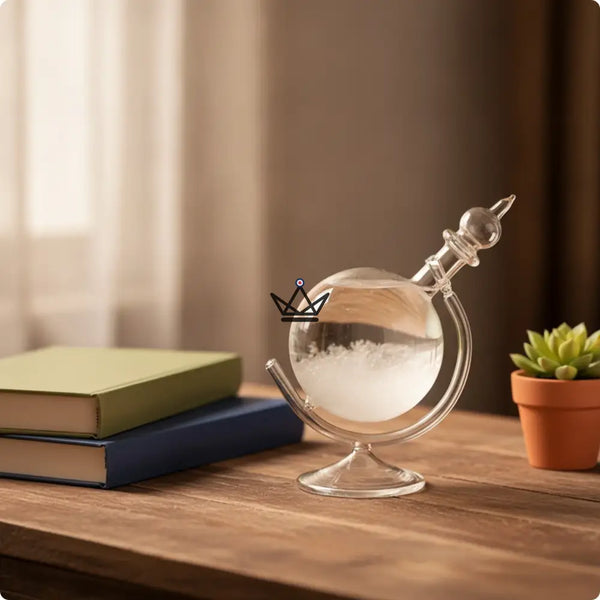


Storm glass globe crystal barometer - AURORE
🚚 FREE DELIVERY
Tax included
Le Labo Time & Weather Inheriting the legacy of 19th-century sailor’s storm glasses, the AURORE crystal barometer encloses a clear liquid within a transparent glass sphere where, over the days, delicate white crystals that resemble snow begin to form. Its slender neck is topped with a globe-style glass stopper, a nod to the great voyages of exploration. The collection includes three versions: two models feature a decorative rose, red or blue, suspended at the heart of the sphere and supported by a dark wood arched stand on a round base; the third, more minimalist, dispenses with the flower and rests on a transparent glass base, for a crystalline levitation effect. Placed on a desk, bookshelf, or entryway console, this storm glass becomes an object of contemplation: each morning, the forest of crystals has changed its appearance, becoming denser, finer, or almost dissolved. A piece of scientific curiosity with a romantic charm, designed for lovers of curiosity cabinet objects and poetic decor.
The three available versions
The two rose versions lean into romanticism and the warmth of wood; the Crystal version, made entirely of glass, focuses on graphic purity and fits perfectly in a contemporary or minimalist interior. In all three cases, the sphere and its globe-shaped stopper remain identical.
The storm glass: a curiosity born at sea
The storm glass was popularized in the 19th century by Admiral Robert FitzRoy, a navigator and meteorology pioneer who described its various appearances in his notes. The principle is based on a solution traditionally composed of camphor, ethanol, water, and salts, sealed in glass. Depending on the ambient temperature, the solubility of these components varies: crystals appear, grow, branch out, or dissolve.
Tradition attributes to the storm glass the ability to predict upcoming weather: clear liquid for fair weather, star-shaped crystals for cold weather, or suspended flakes before snowfall. The scientific reality is more nuanced: temperature is the primary factor, and the object should be considered a decorative and educational piece, not a professional meteorological measuring instrument. This is precisely what makes it so charming: observing, every day, a slow, ever-changing crystallization.
Why you'll love it
A rose in the storm
There is something in this barometer of the cabinets of curiosities of old and the tales we reread in winter. A glass sphere, a clear liquid, and, at the center, an immobile rose while the crystals rise around it like slow-falling snow. Light passes through the glass, catches the edges of the crystals, and makes the miniature globe crowning the neck shine.
On its dark wood arch, the sphere seems suspended, almost floating. The Crystal version pushes this idea further: an arch and base in transparent glass blend into the background, leaving all the room for the crystallization. Each morning, a glance is enough to discover a new painting, different from the one the day before.
Installing your crystal barometer
Comparison of versions
| Criteria | Red Rose | Blue Rose | Crystal |
|---|---|---|---|
| Interior decor | Red rose | Blue rose | No flower |
| Support | Dark wood arch and round base | Dark wood arch and round base | Transparent glass arch and base |
| Ambiance | Romantic, warm | Poetic, contrasting | Minimalist, contemporary |
| Crystal reading | Around the flower | Around the flower | Clear, without decor |
| Ideal for | Valentine's Day, birthday | Original gift, desk | Minimalist interior |
Le Labo also offers another model of crystal barometer with a different shape, as well as objects for measuring time: find them in our time and weather objects collection.
Good to know: crystallization depends primarily on ambient temperature. In a room with constant heating, the crystals may remain stable for several days; near a window, they will evolve more. After shipping, it is normal for the liquid to appear cloudy or for the crystals to be broken: a few days of rest is usually enough to see them reform.
Tip: for a spectacular effect, place the barometer in front of a soft light source (desk lamp, window without direct sun). Take a photo every morning for a week: the comparison of the crystals is amazing and allows you to establish your own connection between their appearance and the room temperature.
Technical specifications
| Type | Decorative crystal barometer (storm glass) |
| Shape | Sphere with fine neck and globe-style stopper |
| Sphere material | Transparent glass |
| Contents | Sealed crystallization liquid |
| Red Rose version | Red rose inside sphere, dark wood arch and round base |
| Blue Rose version | Blue rose inside sphere, dark wood arch and round base |
| Crystal version | No flower, transparent glass arch and base |
| Power source | None (passive operation) |
| Dimensions | Not provided |
| Weight | Not provided |
| Usage | Interior decoration, desk object, scientific curiosity |
Precautions: fragile glass object containing liquid: do not open, do not ingest contents, do not shake violently. Keep out of reach of young children and pets; not suitable for children under 3 years old. Avoid direct sunlight, proximity to radiators or flames. This is a decorative object: it does not replace a barometer or thermometer for precise measurement.
A poetic and unique gift idea
With its rose suspended under a snow of crystals, AURORE is a Valentine’s Day or birthday gift that goes off the beaten path. The Crystal version will appeal more to curious minds, science or navigation enthusiasts, and will find its place on a desk as a farewell or thank-you gift.
To put together a set centered on scientific curiosity, explore Le Labo's scientific objects or browse our selection of original decoration.
Frequently asked questions
How does a crystal barometer work?
A crystal barometer, or storm glass, contains a sealed solution whose components dissolve differently depending on the temperature. As the room cools, some of the components crystallize to form needles, stars, or white snow; when it warms up, these crystals may partially dissolve. Maritime tradition associated these appearances with weather changes, but temperature remains the determining factor. AURORE should therefore be viewed as an educational and decorative object that makes a physico-chemical phenomenon visible, rather than as a certified meteorological forecasting instrument. This element of mystery and observation is what makes it so charming day-to-day.
The crystals are broken or the liquid is cloudy upon arrival; is that normal?
Yes, that is completely normal. During transport, the sphere is subject to vibrations and temperature changes that disturb the crystals: they may break, settle at the bottom, or make the liquid look slightly cloudy. Simply place the barometer in a stable location, away from sun and heat sources, and let it rest for a few days without handling it. The solution will stabilize and new crystallization will gradually form. Avoid shaking the object to speed up the process: this will only delay the formation of clean crystals. With a little patience, the characteristic snowy landscape will reappear.
What is the difference between the three versions?
The three versions share the same glass sphere and the same globe-style stopper. The Red Rose and Blue Rose versions feature a decorative rose in the center of the sphere and rest on an arched stand and round base made of dark wood: they offer a warm and romantic ambiance. The Crystal version contains no flower and rests on an arch and base in transparent glass, for a more minimalist look where the crystallization occupies the entire space. The choice therefore depends mainly on your interior and the person you are gifting it to: romance for the roses, graphic sobriety for the Crystal version.
Can you really predict the weather with this barometer?
You should remain cautious. Historically, sailors and Admiral FitzRoy observed the storm glass to try to anticipate the weather, and a popular tradition associates certain crystal appearances with weather conditions: clear liquid, star-shaped crystals, suspended flakes. Modern observations show, however, that it is primarily temperature that influences crystallization. AURORE is therefore not a measuring instrument: it does not replace a dial barometer or a weather station. However, it allows you to observe the effect of thermal variations in your interior in a very visual way, making it a fantastic source of curiosity and discussion.
Where should I place the crystal barometer in the house?
Choose a stable surface, outside of high-traffic areas where it might be bumped. Avoid direct sunlight, which would heat the sphere and dissolve the crystals, as well as proximity to radiators, fireplaces, or stoves. A bookshelf, desk, entryway console, or unused fireplace mantel are all very suitable. If you want to observe more variations, a room where the temperature fluctuates slightly between day and night will make the crystallization more lively. For display, a soft light placed behind or next to the sphere highlights the white crystals.
Do I need to maintain the barometer or change the liquid?
No, no special maintenance is required. The solution is sealed within the sphere and must never be opened or replaced: opening it would compromise the airtight seal and the proper functioning of the object. For cleaning, a simple soft, dry cloth, or one that is very slightly damp, is enough to dust the glass and the stand. Avoid abrasive products or solvents. The object contains no batteries or mechanisms: it functions entirely passively. Just remember to handle it with care when dusting, holding the sphere with both hands rather than by the neck or stopper, which are thinner and more fragile.
What are the dimensions of the AURORE barometer?
Precise dimensions were not provided to us by our supplier, and we prefer not to provide approximate figures. The photos show an object of decorative format, intended to be placed on a desk, shelf, or console, with a sphere held by an arch over a round base. If size is a determining factor for your needs (specific location, display case, alcove), do not hesitate to contact our team before placing your order: we will respond with the information available to us. The three versions share the same sphere; only the nature of the support, dark wood or transparent glass, differs.
