


Demonstration looping track, single or double loop - CENTRA
🚚 FREE DELIVERY
Tax included
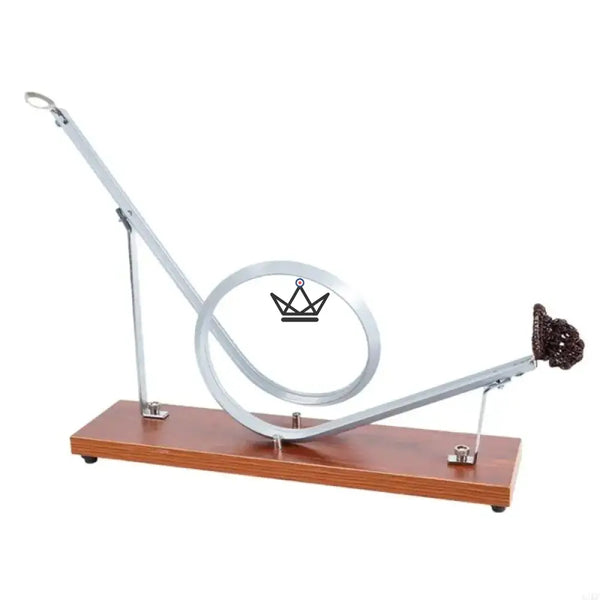
The Lab Educational Equipment How high must the marble be raised to complete the loop? This demonstration loop track turns the question into an experimental protocol. Its V-profile aluminum rails launch from a long starting ramp, trace one or two vertical loops, and then end in a catching net that collects the marble at the finish. The whole assembly is mounted on a wooden base approximately 40 cm long. Two versions are available: the single loop for a direct demonstration, or the double loop, which combines a large circle of approximately 7 cm in radius with a small one of approximately 3.5 cm to compare passage thresholds. According to the manual, the demonstrator comes with a steel marble and a plastic marble 2.5 cm in diameter: perfect for testing the influence of mass and observing that it changes almost nothing. Conservation of energy, minimum speed at the summit, friction: every launch becomes a measurement, every failure a hypothesis to be reformulated.
Available versions
Energy, height, and critical velocity
Released at the top of the ramp, the marble possesses gravitational potential energy proportional to its height. As it descends, this reserve is converted into kinetic energy. Part of this energy is then reinvested to regain altitude in the loop. The balance, established by 19th-century physicists under the name of conservation of mechanical energy, allows for the prediction of the marble's speed at every point of the journey, friction notwithstanding.
At the top of the circle, the only question is whether the marble is moving fast enough for the curved trajectory to be sustainable: v² ≥ g·R is required. Coupled with the energy balance, this condition provides a minimum starting height of 2.5 times the radius for an object that slides, and approximately 2.7 times the radius for a solid marble that rolls, because it also stores energy in its rotation. With two loops of different radii, you can verify that the small circle can be cleared from a much lower starting point than the large one.
What this demonstrator brings
The laboratory classroom, an elegant version
In the high schools of yesteryear, physics cabinets lined up wood-and-brass demonstration apparatuses designed so that an entire class could see the phenomenon from the back of the room. This loop track follows in that tradition: a sturdy wooden base, neat aluminum rails, and a path that can be read from a distance.
But its real wealth lies elsewhere: it invites you to measure. Identify the starting height, note the result, try again a little lower, compare the large and small loops, swap the steel marble for the plastic one. In half an hour, students retrace the intellectual path of the scientists who founded mechanics: observe, conjecture, verify. And at home, the object keeps that little thrill intact when the marble hesitates at the summit.
Four-step protocol
Comparison of the two versions
| Criterion | Single loop | Double loop |
|---|---|---|
| Number of loops | One | Two, of different radii |
| Radius/radii indicated | Not specified for this version | ≈ 7 cm and ≈ 3.5 cm |
| Rail | V-profile aluminum | V-profile aluminum |
| Base | Wood, ≈ 40 cm | Wood, ≈ 40 cm |
| Marbles (manual) | Steel and plastic, Ø 2.5 cm | Steel and plastic, Ø 2.5 cm |
| Key experiment | Find minimum passage height | Compare radius effect on threshold |
| Recommended audience | Discovery, middle school, office | High school, higher ed, enthusiasts |
Want to explore other mechanical phenomena? Our physics and motion collection brings together pendulums, motors, and demonstrators that ideally complement this track.
Good to know: the loop radii and marble diameters are those indicated in the manufacturer's manual; the base length is estimated from a photo. The manufacturer does not specify the total height, weight, or whether the device is delivered pre-assembled.
Tip: film the passes in slow motion with a smartphone placed facing the loop. Frame by frame, you can clearly see the marble slow down at the summit, and sometimes lift slightly off the rail just before stalling: an excellent aid for an experimental report.
Technical specifications
| Type | Demonstration loop track (centripetal force) |
| Versions | Single loop or double loop |
| Rails | Aluminum, V-profile |
| Loop radius (double version) | ≈ 7 cm and ≈ 3.5 cm (manual) |
| Marbles (manual) | 1 steel marble and 1 plastic marble, Ø 2.5 cm |
| Base | Wood |
| Base length | ≈ 40 cm (photo estimate) |
| Finish | Marble catching net |
| Operation | Gravity, no power supply |
| Concepts covered | Energy conservation, centripetal force, minimum speed at summit |
| Height / weight | Not provided |
Precautions: the marbles are small parts: not recommended for children under 3; with children, an adult must always supervise the experiment. The steel marble can damage floors or fragile objects if dropped: work over a table. Do not bend the rails, as their shape is critical to successful runs.
A gift for minds that want to understand
This demonstrator will delight a physics teacher who wants to refresh their lessons, a high school or prep school student, a science club, or a parent who enjoys conducting experiments with their teenagers. It is also an original gift for a mechanical engineer or a roller coaster enthusiast.
To complete the set, discover the entire selection of scientific objects from The Lab or a puzzle from our puzzles and office collection.
Frequently asked questions
Should I choose the single or the double loop?
It all depends on what you want to show. The single loop is enough to introduce centripetal force and search for the minimum starting height: it is the most readable version for a first discovery or for an office. The double loop adds a valuable comparative dimension: with a large circle of approximately 7 cm in radius and a small one of 3.5 cm, it shows concretely that the passage threshold depends on the radius. For use in class, in a science club, or for an enthusiast who likes to experiment, the double version offers significantly more experimental scenarios.
What are the two marbles provided for?
According to the manual, the demonstrator comes with a steel marble and a plastic marble of the same diameter, 2.5 cm. Comparing them illustrates a result that is often surprising: the condition for passing the summit does not depend on the mass. Indeed, mass appears on both sides of the energy and force equations, and cancels out. In practice, slight differences may appear because the lighter marble is more sensitive to friction and small imperfections in the rail. Discussing these differences is one of the educational benefits of the experiment, which teaches how to distinguish between a theoretical model and a real-world measurement.
From what height should the marble be released?
The theory provides a clear guideline. For an object sliding without friction, the start must be at least 2.5 radii of the loop, measured from the lowest point of the circle. For a solid marble that rolls, the energy spent on its own rotation raises the threshold to approximately 2.7 times the radius. With a 7 cm radius loop, this represents slightly less than 19 cm of starting height. Real friction increases this value further: this is the whole point of measuring it and comparing it to the calculation.
What academic level is the demonstrator suitable for?
It adapts to many levels. In middle school, one simply observes the link between height and speed and formulates hypotheses. In high school, it illustrates the conservation of mechanical energy and forces in circular motion. In prep school or university, it allows one to explore the rotational energy of the marble and the analysis of friction. It also works very well in scientific outreach or at home with curious teenagers. With young children, the presence of an adult is essential, as the marbles are small parts to be kept out of reach of children under 3.
What is the net at the end of the rail for?
The catching net stops the marble at the end of its run. Without it, a marble launched at full speed would leave the base and roll on the table, or even fall to the floor. It makes series of tests much more fluid: you retrieve the marble in the same place each time, note the result, and start again immediately. It is also a welcome safety feature with the heavier steel marble, which could damage wood flooring or hit a fragile object if it falls. Simply keep the space in front of the net clear so the marble can enter freely.
Why V-shaped rails?
The V-profile creates two points of contact between the marble and the rail. The marble is thus naturally centered and guided throughout the length of the path, including in the inverted part of the loop, where a flat rail would let it drift laterally. This guidance improves the reproducibility of trials: at the same starting height, the marble follows the same trajectory from one launch to the next, which is essential for measuring a passage threshold. Aluminum, being light and rigid, retains its shape well. Regular dusting with a dry cloth is enough to preserve the quality of the roll.
Is the demonstrator delivered assembled?
The manufacturer does not specify whether the device is shipped fully assembled or if certain elements, such as the net or the rails, must be attached to the base upon receipt. We prefer not to claim anything we cannot guarantee. The photos show a simple assembly consisting of the wooden base, the aluminum rails, and the catching net, without any mechanism or electronics. If this information is decisive for you, for example to prepare a lab session for a specific date, contact us before your order and we will respond with the elements we have available.
